
Introduction
Colorectal cancer is one of the most common malignant tumors of the digestive tract worldwide. The key to reducing its incidence lies in the early endoscopic resection of precancerous lesions—colorectal polyps. With the widespread adoption of Endoscopic Mucosal Resection (EMR) and Endoscopic Submucosal Dissection (ESD), an increasing number of large colorectal polyps can be removed minimally invasively. However, postoperative bleeding, as the most common complication, with an incidence rate of 5%-10%, remains a persistent challenge for clinicians. For large post-EMR/ESD wounds, traditional hemostatic methods like clipping or coagulation often face limitations. This article explores the significant role of a new plant-based absorbable hemostatic powder in preventing and controlling postoperative bleeding, based on the latest clinical research.
I. Clinical Challenge: The Difficulty of Preventing Bleeding After Large Polyp Resection
For colorectal polyps larger than 20mm, EMR/ESD procedures create large and deep wounds. Traditional hemostatic methods, such as metal clip closure or electrocoagulation, often encounter difficulties when dealing with irregular or extensive wound surfaces. These challenges include difficult application, incomplete closure, and the risk of delayed bleeding. The risk is particularly high in elderly patients or those using antiplatelet/anticoagulant medications. This not only increases patient suffering from secondary interventions but also adds to the medical burden. Therefore, there is an urgent clinical need for a postoperative bleeding prevention solution that is easy to use, provides comprehensive coverage, and offers a reliable effect.
II. Cutting-Edge Research: Validation of Plant-Based Absorbable Hemostatic Powder Efficacy
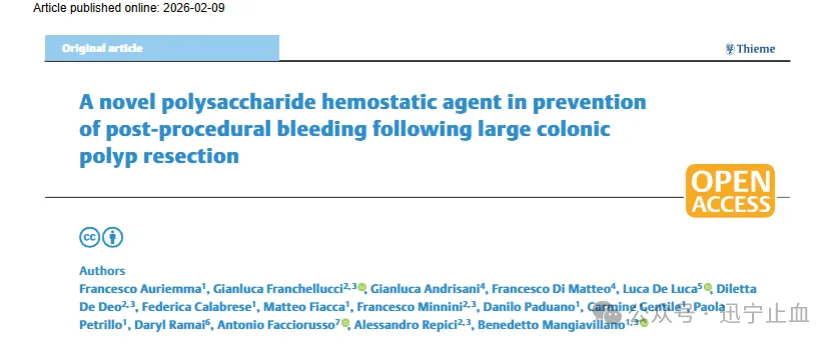
A recent multicenter prospective exploratory study published in the authoritative journal 《Endosc Int Open》 provides new evidence-based support for preventing bleeding after large colorectal polyp resection.
- Study Subjects: The study enrolled 50 patients who underwent EMR or ESD for large colorectal polyps. The average diameter of the lesions was 52.28mm, 86% were adenomatous polyps, and the cohort included some patients with high-risk factors (e.g., using antiplatelet/anticoagulant drugs).
- Intervention: After resection, plant-based absorbable hemostatic powder was sprayed onto all wounds. No endoscopic clips were used.
- Results:
- Low Bleeding Rate: The incidence of delayed postoperative bleeding was only 6%. All bleeding events occurred within 24 hours post-surgery, with no new cases within 30 days.
- High Safety Profile: Univariate analysis showed no statistically significant correlation between postoperative bleeding and lesion size, patient age, or resection method. No other complications like perforation or infection were observed during the study.
- Conclusion: The study demonstrated that applying absorbable hemostatic powder in high-risk patients effectively prevents postoperative bleeding, showing good safety and feasibility. This offers a new clinical strategy for managing wounds after large polypectomy.
III. Technology Analysis: How Xunning® Hemostatic Powder Achieves Efficient Hemostasis and Protection
The advantages of the plant-based absorbable hemostatic powder used in the study above stem from its scientific composition and mechanism of action. Take Xunning® Hemostatic Powder, a mature clinical solution in China, as an example. Its core components are cross-linked potato starch and sodium carboxymethyl starch, ensuring surgical safety through multiple mechanisms:
- 1. Ultimate Safety, No Residual Concerns
- 100% Plant-Based: Uses dual plant-based components, eliminating the risk of animal-borne pathogens, with no antigenicity or immune reactions.
- Rapid Metabolism: Confirmed by tests from the Chinese Academy of Military Medical Sciences, the powder degrades within 2 days, absorbs within 7 days, and is completely eliminated from the body within 30 days, demonstrating excellent biocompatibility.
- 2. Triple Mechanism for Rapid Hemostasis
- Physical Absorption: Utilizes dual吸水 effects from a “molecular sieve” and hydrophilic groups to rapidly concentrate blood.
- Coagulation Activation: Activates the endogenous coagulation system, accelerating the clotting process.
- Fast Gel Formation: These triple mechanisms work synergistically to form a stable gel in approximately 9.19 seconds, adhering firmly to the wound surface and significantly reducing intraoperative and postoperative bleeding.
- 3. Precise Application, Covering All Scenarios
- Easy Operation: Comes with a specialized endoscopic delivery catheter, enabling precise application to deep cavities and irregular wounds, addressing the limitations of traditional instruments.
- Broad Applicability: Suitable for various surgical scenarios, including open, laparoscopic, and endoscopic procedures, meeting the needs of different departments.
IV. Clinical Value: Full-Cycle Management from Hemostasis to Healing
The value of Xunning® Hemostatic Powder extends beyond immediate hemostasis to encompass the entire postoperative recovery process:
- Immediate Hemostasis: Rapidly controls bleeding from capillaries, small arteries, and veins, optimizing the surgical field to ensure a smooth procedure.
- Prevents Delayed Bleeding: The stable gel continuously compresses the wound and reinforces the clot, effectively reducing the risk of re-bleeding, especially 24 hours post-surgery, and minimizing the need for secondary interventions.
- Physical Anti-Adhesion: Forms a dense biological barrier on the wound surface, effectively isolating tissue fluids and friction between organs, thereby reducing postoperative adhesions and related complications.
- Promotes Wound Healing: Maintains a relatively dry and clean wound environment, creating favorable conditions for cell regeneration. It induces the growth of fibroblasts and epithelial tissue, accelerating mucosal healing and shortening the patient’s recovery time.
Conclusion
With the advancement of minimally invasive endoscopic techniques, higher demands are placed on surgical safety and postoperative recovery quality. Recent clinical studies confirm that plant-based absorbable hemostatic materials, represented by Xunning® Hemostatic Powder, offer a powerful new tool for preventing bleeding after large colorectal polypectomy, thanks to their high efficacy, safety, and ease of use. They not only solve the pain points of traditional methods but also support the entire process from intraoperative hemostasis to postoperative healing, making them a vital choice for improving the overall standard of minimally invasive treatment for colorectal diseases.
Follow us to learn more about the product and clinical cases.
Product Name|Xunning® Absorbable Composite Polysaccharide Hemostatic Powder